AI Cybersecurity Risk: Friend or Foe for Your Business?
AI: Friend or Foe? The Real Risk Isn’t What You Think
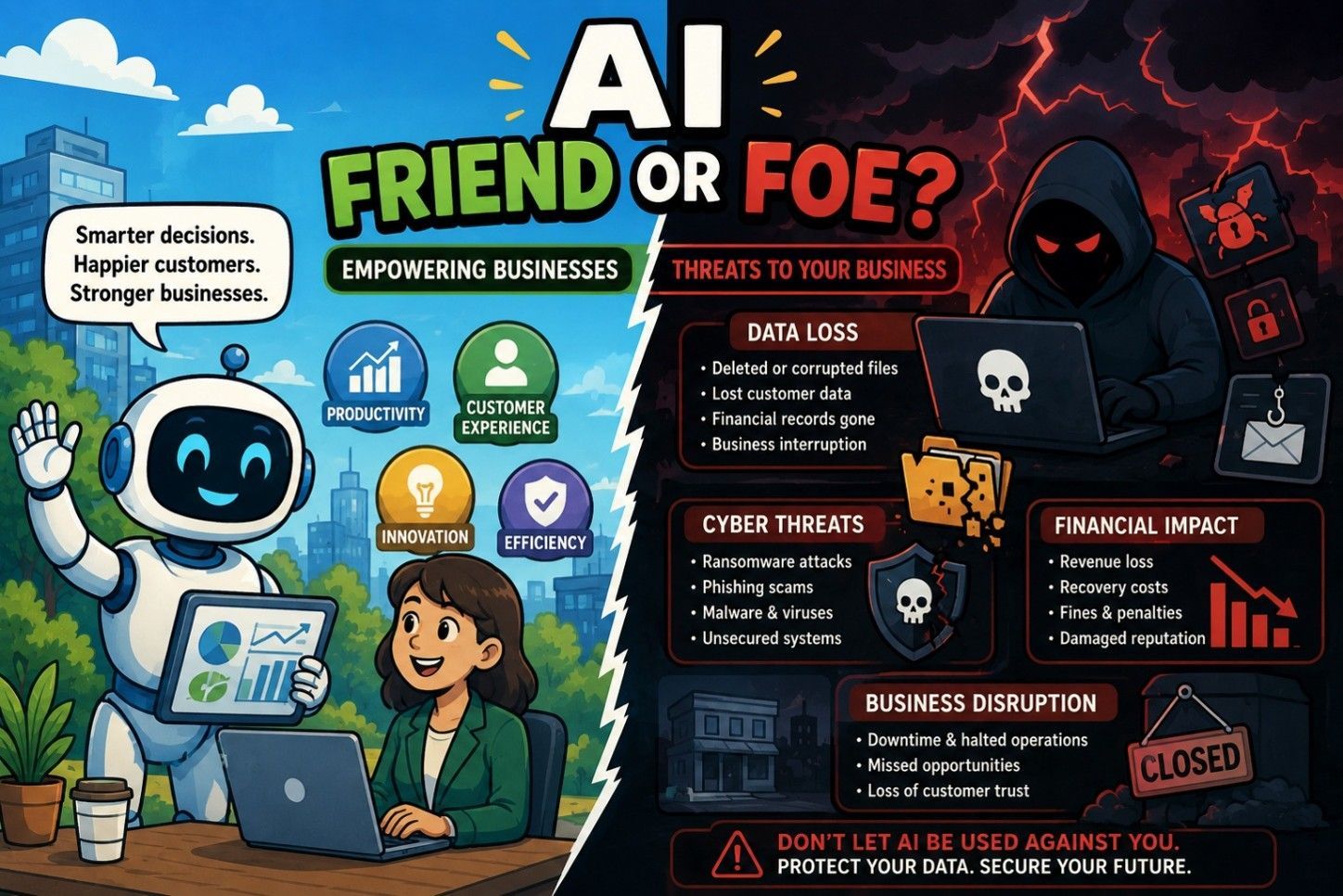
Artificial Intelligence is often framed in extremes. It is either the future of innovation or a looming threat to control. Headlines lean into fear or hype, but the reality is far more practical and far more immediate.
AI is neither inherently a friend nor a foe. It is an amplifier. And what it amplifies depends entirely on how it is used.
The Acceleration of Everything
AI does not just improve processes. It accelerates them.
For businesses, this creates clear advantages:
- Faster data analysis and decision-making
- Increased operational efficiency
- Automation of repetitive tasks
- Scalable content and product development
But the same acceleration applies to threats:
- Faster execution of cyber attacks
- More convincing phishing and social engineering
- Automated vulnerability discovery
- Scaled misinformation and manipulation
The technology itself is neutral. The outcomes are not.
Where the Real Risk Lives
The conversation around AI often focuses on the technology. But the real risk is not in the model, it is in how organizations adopt and integrate it.
In many cases, AI is deployed faster than it is understood.
- Employees use AI tools without clear guidelines
- Sensitive data is entered into unsecured systems
- Outputs are trusted without verification
- Governance frameworks lag behind implementation
This creates a familiar pattern. Innovation moves forward. Security tries to catch up.
AI and the Expansion of the Attack Surface
Every new tool introduces a new entry point. AI is no different, except it operates at scale.
Attackers are already leveraging AI to:
- Generate highly personalized phishing campaigns
- Mimic communication styles and identities
- Automate reconnaissance on organizations
- Identify and exploit weak access controls
At the same time, organizations are integrating AI into workflows without fully understanding the exposure it creates.
The result is an expanded attack surface, often without a corresponding increase in protection.
Trust, Accuracy, and Control
AI introduces another challenge that is less visible but equally important: trust.
Outputs can appear confident, structured, and credible, even when they are incorrect.
Without proper validation:
- Decisions can be made on flawed information
- Internal processes can be compromised
- Misinformation can spread unintentionally
Control becomes the defining factor. Not just over systems, but over how information is generated, reviewed, and used.
The Balance Between Opportunity and Risk
AI presents a clear opportunity for growth, efficiency, and innovation. But it also introduces new layers of complexity that organizations cannot afford to ignore.
The difference between AI as a competitive advantage and AI as a liability comes down to:
- Governance
- Visibility
- Access control
- Employee awareness
Without these, the line between friend and foe becomes increasingly blurred.
Key Takeaways
AI is not a distant risk. It is a present force shaping how businesses operate, compete, and defend themselves.
Organizations that treat AI as purely an opportunity often overlook the risks. Those that focus only on the risks miss the opportunity.
The goal is not to choose a side. It is to understand both.
Because AI does not change the fundamentals of security. It amplifies them.
Take Action Before AI Becomes a Liability
If your organization is adopting AI quickly but your security and governance haven’t caught up, you’re not alone—and that gap is where risk grows.
The next step is to set clear rules for how AI is used, what data it can access, and how outputs are reviewed—before the tools become embedded across the business.
A quick conversation can help you:
- Identify where AI is already introducing exposure (data leakage, shadow AI, unvalidated outputs)
- Define practical guardrails for acceptable use, access, and vendor/tool selection
- Build a lightweight governance approach your teams will actually follow
- Prioritize the controls that reduce risk without slowing innovation
Ready to put structure around your AI adoption? Contact CyberRN | Cyber Risk Navigator | US to talk through your current use cases and the safeguards that fit your environment.
Because in the age of AI, the question isn’t whether it’s a friend or a foe—it’s whether you’re prepared for what it will amplify in your organization.
CyberRN Blog